
A common misconception is that a crypto wallet keeps a transaction safe merely because it displays a confirmation window. In reality, the decisive question is what the wallet helps the user understand before signing: which contract is being called, on which network, with which permissions, and how the account balance is expected to change. This distinction matters especially for German-speaking DeFi users, who may move between Ethereum, Layer-2 networks and other EVM chains several times in one session. Rabby is designed around that problem. It is not simply a place to store tokens, but a transaction interface intended to make complex on-chain actions more legible.
That does not make Rabby risk-free. A wallet cannot repair a malicious protocol, reverse a signed transaction or protect a user who approves an unexpected action without reading the warning. Its value is therefore best understood as a reduction in avoidable decision errors, not as an insurance policy. The practical comparison is between different layers of control: Rabby’s simulation and warnings, MetaMask’s broad ecosystem familiarity, and hardware wallets’ stronger protection of private-key operations.
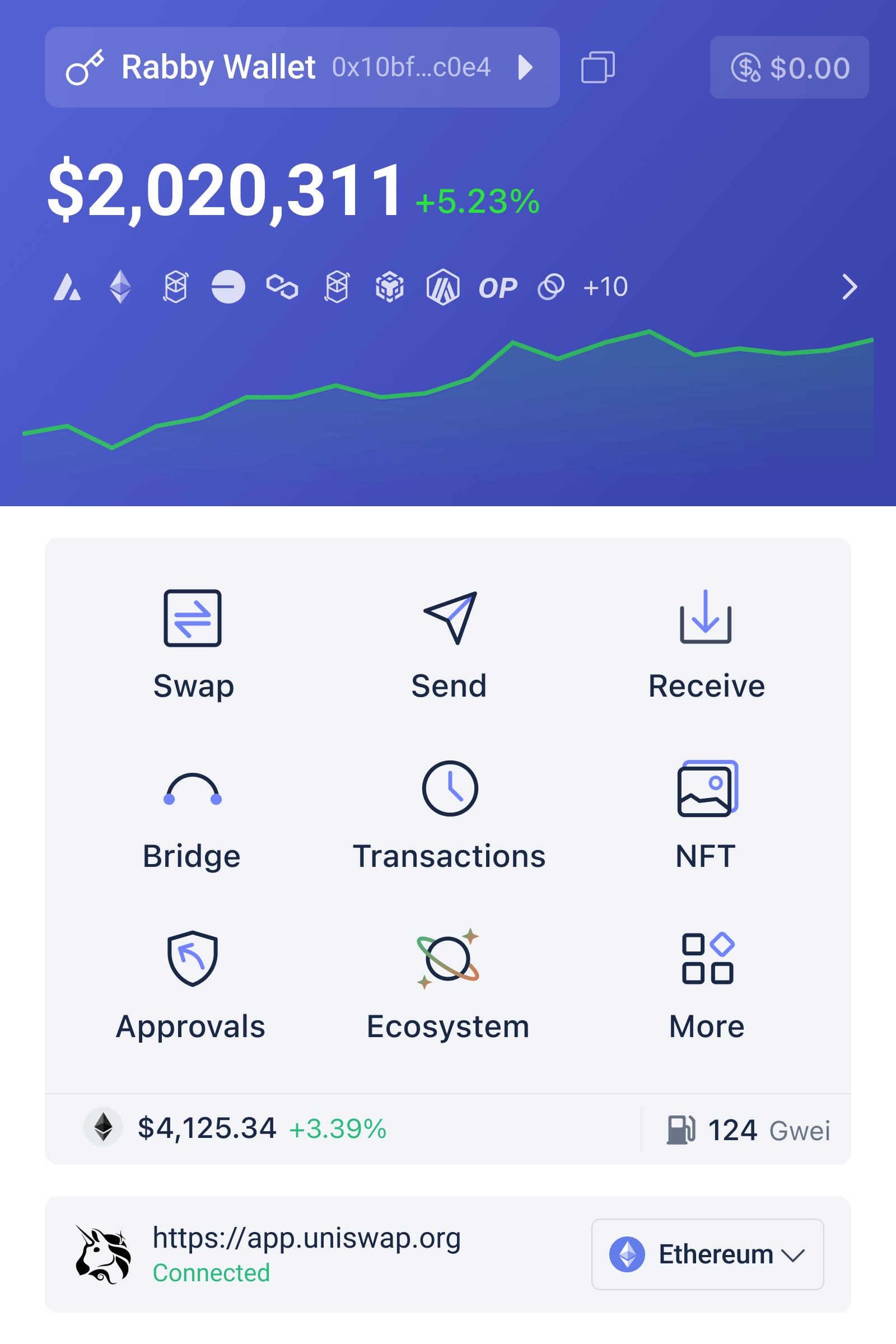
What makes Rabby different from a conventional browser wallet?
Rabby is a non-custodial wallet developed by DeBank for Ethereum and other EVM-compatible networks. Non-custodial means that the user, rather than a platform, controls the private keys. According to the supplied project information, those keys are stored locally on the user’s device and are not sent to Rabby’s servers. This is an important security property, but it also transfers responsibility to the user: a lost recovery phrase, compromised computer or deceptive backup procedure can still lead to permanent loss.
The central design choice is transaction inspection. Before a user signs, Rabby performs a simulation intended to show the expected changes to token balances. Its security engine also checks contracts and addresses for indicators such as phishing, known compromises and potentially unlimited token approvals. An approval is not the same as a token transfer; it gives a contract permission to move specified assets later. That difference is easy to miss in a conventional signing flow and is one reason simulation can be more informative than a simple “confirm” button.
There is also a useful conceptual distinction between a wallet and a transaction originator. Rabby does not independently create or alter a user’s transactions; it acts as an interface and an independent reviewer of the proposed action. Core signing functions can remain usable if Rabby’s own servers are unavailable, although network access, blockchain nodes and the connected decentralised application may still be necessary for other parts of the process. This boundary matters: backend independence is not the same as independence from the wider internet or from the underlying blockchain.
Rabby installieren and rabby wallet herunterladen: the safer workflow
For users searching for “rabby installieren” or “rabby wallet herunterladen”, the first security decision is not a technical one. It is source verification. Browser extensions and desktop applications are attractive targets for impersonation, so users should obtain the software through Rabby’s official distribution channels or a trusted, verified store listing rather than through a random advertisement, forum attachment or search result. A useful starting point for learning about the rabby wallet is the supplied project page, but the same principle remains essential: verify the publisher and never disclose a recovery phrase to an installer, support agent or website.
Rabby is primarily available as a browser extension for Chrome, Brave and Edge, with desktop versions for Windows and macOS and mobile applications for iOS and Android. After installation, a cautious setup involves creating or importing a wallet, recording the recovery phrase offline, checking the extension’s permissions and testing the interface with a small amount. A hardware wallet can add a separate signing barrier, and Rabby supports devices including Ledger, Trezor and OneKey. The browser extension then becomes an interaction layer while the hardware device keeps the key operation physically separated from the computer.
Automatic network switching is convenient when a decentralised application requests a particular chain. Rabby supports more than 140 EVM-compatible networks, including Ethereum, Polygon, Arbitrum, Optimism, Avalanche, Base and BNB Chain. Yet convenience has a trade-off. A network switch can reduce manual mistakes, but it can also make chain context less visible to an inattentive user. Before signing, the user should still confirm the network, the asset, the contract address and the expected result. Automation removes friction; it does not remove the need for situational awareness.
Comparison: Rabby, MetaMask and hardware-first custody
Rabby versus MetaMask
MetaMask remains a familiar general-purpose gateway to many EVM applications and benefits from wide recognition among users and developers. For someone who mainly needs a simple account interface and occasional interaction with established applications, that familiarity may be sufficient. Rabby is more specifically shaped around multi-chain DeFi. Its transaction simulation, security warnings, automatic network handling and portfolio-oriented presentation are intended to answer questions that become more important as the number of protocols and networks grows.
The trade-off is not that one wallet is universally secure and the other is not. Security depends on the complete operating environment: browser hygiene, recovery-phrase storage, contract selection, approval management and user behaviour. Rabby’s warnings can improve the quality of information available before signing, but warning systems can have incomplete data, produce false positives or fail to identify a newly deployed attack. MetaMask’s simpler or more familiar workflow may be easier for some users to understand. The better choice depends on whether the user values richer inspection or minimal interface complexity.
Rabby versus a hardware wallet
A hardware wallet addresses a different threat model. It is primarily concerned with protecting the private key and requiring a physical confirmation for signing. Rabby’s simulation and scanner, by contrast, focus on interpreting the transaction and its likely consequences. These are complementary controls rather than substitutes. A hardware device may prevent a remote attacker from silently using a key, while Rabby may help a human notice that a legitimate-looking dApp is requesting an excessive approval.
The limitation is that neither layer can guarantee economic safety. A user can confirm a carefully simulated but economically harmful trade, bridge assets into a risky protocol or accept a price affected by slippage. Rabby integrates bridge protocols such as LI.FI and offers a swap aggregator that can examine routes involving services such as Uniswap and 1inch. Better routing may reduce friction or improve execution, but it introduces dependence on several protocols, liquidity conditions and route-specific risks. “Best exchange rate” is always conditional on the moment, liquidity and selected parameters.
Rabby versus leaving funds on an exchange
A centralised exchange can be simpler for buying and selling and may provide account recovery mechanisms that self-custody does not. However, exchange users rely on the platform’s custody, withdrawal policy and operational resilience. Rabby offers direct control and direct dApp access, but the user assumes responsibility for keys and on-chain approvals. For many German users, the meaningful comparison is therefore not between two brands but between two accountability models: institutional recovery versus personal control.
The less obvious risk: interpretation can become overconfidence
Transaction simulation is valuable because it converts opaque contract calls into a more understandable expected outcome. But a simulation is a model of a state transition, not a promise about the future. It may not capture every external dependency, price movement, block-ordering effect or later action by a contract. A transaction that appears to exchange one asset for another can still expose the user to market volatility, bridge risk, approval risk or a protocol exploit after the transaction has completed.
This suggests a practical rule for using Rabby: treat a clean simulation as a reason to continue investigating, not as permission to stop thinking. For larger positions, compare the displayed result with the dApp’s own interface, inspect whether an approval is limited or unlimited, and consider using a separate wallet for experimentation. A hardware wallet is particularly sensible for long-term holdings, while a smaller operational wallet can be used for routine DeFi activity. Separating those roles reduces the impact of one mistaken signature.
The same caution applies to Rabby Points, which may be earned through activities such as swaps, gas top-ups or referrals. Loyalty incentives can make an interface more engaging, but they may also encourage unnecessary transactions. The cost of gas, slippage and smart-contract exposure should be evaluated independently of any points programme. A reward has no protective value if the underlying activity is unsuitable for the user’s risk tolerance.
Gas, bridges and the practical multi-chain experience
Rabby’s Gas Account can allow users to pay network fees with stablecoins such as USDC, including in situations where they do not hold the native token of a particular chain. This solves a familiar operational problem: assets may be present on a network while the small amount needed for gas is not. Nevertheless, fee abstraction does not eliminate fees. It changes how the user supplies them and may involve conversion, service availability or additional execution conditions. Users should check the final cost rather than assuming that paying in a stablecoin is automatically cheaper.
Bridges create a similar distinction between convenience and risk. An integrated route can make moving assets across chains feel like one action, but the underlying operation may involve multiple contracts and liquidity providers. The interface can simplify navigation; it cannot make the bridge’s security model equivalent to that of the source or destination chain. Before bridging, users should identify what asset will arrive, whether it is native or wrapped, which contracts are involved and what happens if the route fails or becomes illiquid.
What to watch as DeFi wallets evolve
The recent project messaging supplied for 23 August 2026 presents Rabby as a broad wallet for Ethereum and EVM activity, emphasising speed, security and support across chains. The more important trend behind that messaging is functional convergence: wallets increasingly combine signing, simulation, swaps, bridging, fee management and portfolio context. If this direction continues, the wallet may become less like a passive key container and more like a risk-sensitive execution environment.
That scenario has two possible outcomes. Better context could reduce routine mistakes, particularly for users navigating several Layer-2 networks. At the same time, a feature-rich interface could conceal the number of underlying dependencies and make users overconfident. The evidence needed to judge the balance would include how accurately warnings perform in real use, how clearly failed or partial operations are explained, and whether users actually change behaviour after seeing simulations. For now, the prudent conclusion is conditional: Rabby’s design is most useful when its information is treated as decision support rather than authority.
Frequently asked questions
Is Rabby safer than MetaMask?
It may provide stronger transaction context for multi-chain DeFi through simulation, security warnings and network-aware presentation, but “safer” is not absolute. Both are non-custodial tools whose security depends on the device, recovery-phrase handling, dApp choice and user decisions. Rabby is a strong fit for users who want more pre-signing information; MetaMask may suit users who prefer a familiar, broadly integrated workflow.
Can Rabby protect me from a malicious smart contract?
It can flag some known or detectable risks and show the expected balance changes before signing. It cannot guarantee detection of every attack, and it cannot reverse a transaction once it has been confirmed. Users should treat warnings and simulations as one control within a broader process that includes checking contract identity, limiting approvals, using small test amounts and protecting high-value funds with a hardware wallet.
Should I use the Rabby browser extension or a hardware wallet?
They serve different purposes. The extension provides the interface for interacting with dApps and reviewing transactions, while a hardware wallet provides stronger isolation for private-key signing. For meaningful holdings, combining both can offer better defence in depth than relying on either one alone. The remaining human decision—whether the transaction itself is economically and operationally sensible—cannot be outsourced.
Rabby’s most defensible advantage is therefore not a claim of perfect security. It is the attempt to make the moment before signing more informative, especially in a fragmented EVM environment. For users deciding how to rabby installieren or rabby wallet herunterladen, the useful framework is simple: verify the software source, protect the recovery credentials, inspect the simulated outcome, distinguish interface convenience from protocol safety, and use hardware-backed signing when the potential loss justifies it. A wallet is only as protective as the decisions it helps the user make—and the decisions the user is still willing to question.
